

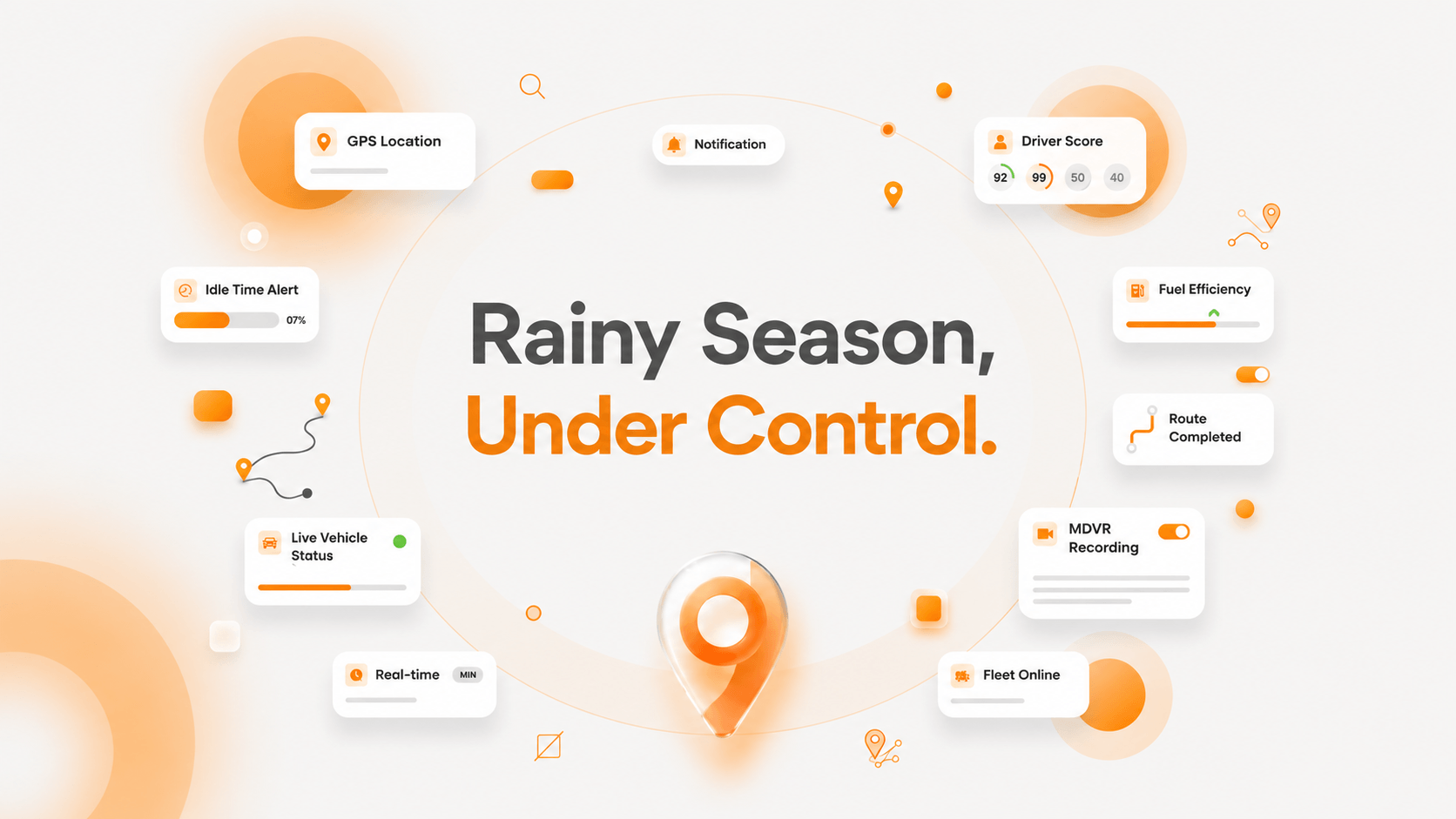
Rainy season changes how every fleet operates in the Philippines, and the right fleet management software can be the difference between absorbing the cost of flooding and traffic season after season, or finally getting ahead of it. Flooded intersections, extended traffic, and reduced visibility don’t just slow deliveries down. They quietly reshape a fleet’s cost structure and risk exposure for months at a time.
Fleet managers who treat this as a seasonal inconvenience tend to absorb the cost without ever seeing where it comes from. Fleet managers who use fleet management software to turn it into a data problem can catch it early, and often recover the cost of visibility many times over.
Good fleet management software earns its keep in exactly these conditions. When routes get unpredictable and risk goes up, having one dashboard for location, fuel, and driver behavior turns a chaotic season into a manageable one. Here’s where that shows up first.
When a vehicle sits in floodwater or gridlock with the engine running, it isn’t just wasting time. It’s burning fuel with nothing to show for it. Based on fuel sensor data collected from actual TrackMe Suite clients, idling can consume as much as 3.7 liters of fuel per hour.
Across a fleet of even a dozen vehicles, an hour of flood-related gridlock during rush hour can translate into a meaningful, recurring fuel cost every time heavy rain hits. Most of that cost goes unnoticed because idle time isn’t usually tracked as its own metric. It gets absorbed into the general fuel budget and written off as “bad traffic.”
With real-time idle time monitoring built into TrackMe Suite’s fleet and logistics platform, fleet managers can see exactly which vehicles are idling, for how long, and where. That turns a vague seasonal cost into a specific, addressable one. Routes prone to flooding can be flagged and adjusted. Drivers who idle longer than necessary can be coached.
This isn’t a case against GPS tracking as the foundation. Idle time visibility is only possible because the core GPS and vehicle data layer is already in place. The fuel insight is a feature built on top of accurate location and engine data, not a replacement for it.
Heavy rain reduces visibility, and reduced visibility changes how drivers respond to sudden obstacles, whether that’s a stalled vehicle ahead, a flooded pothole, or another driver braking without warning.
Driver behavior monitoring, one of the standard features in TrackMe Suite’s fleet management software, picks up on the patterns that tend to spike during these conditions: harsh braking, sudden acceleration, and sharp swerving. During rainy season, a rise in these events on a specific route or with a specific driver is worth investigating before it becomes an incident. Coaching a driver after three flagged hard-braking events in one week is a much better outcome than responding to an accident report.
When an incident does happen during heavy rain, whether it’s a minor collision, a false claim from another party, or a dispute over what actually occurred at a flooded intersection, MDVR footage becomes the fastest way to establish what happened.
Instead of relying on driver accounts alone, fleet managers have a timestamped, location-tagged video record. This matters most during rainy season, when visibility disputes and flood-related incidents are more common, and when insurance or client conversations often come down to “what does the footage show.”
Fleet teams heading into the wetter months can use a simple set of questions to check whether their fleet management software is actually being used to its full potential:
Are idle time reports being reviewed weekly, not just monthly? Are flood-prone routes flagged in the system so dispatch can route around them? Are MDVR units installed and functioning across the fleet, not just on a few vehicles? Is driver behavior data being reviewed for seasonal spikes, not just overall averages?
None of these require a new system. They require using the data a GPS-based fleet management platform is already collecting, and asking better questions of it.
Fuel waste from idling, driver safety risk in low visibility, and disputed incidents are all predictable rainy season problems. They’re also all addressable with the right fleet management software behind them.
TrackMe Suite brings idle time tracking, MDVR footage, and driver behavior monitoring into a single platform, built on the same GPS foundation fleets already rely on for day-to-day operations, and backed by WTI’s LTFRB-accredited track record as a fleet management provider in the Philippines. This rainy season, that visibility is the difference between absorbing the cost and managing it.
Interested in seeing how TrackMe Suite’s fleet management software supports fleet operations through rainy season conditions? Contact us to learn more.
This website uses cookies to ensure you get the best experience on our website. Learn more