

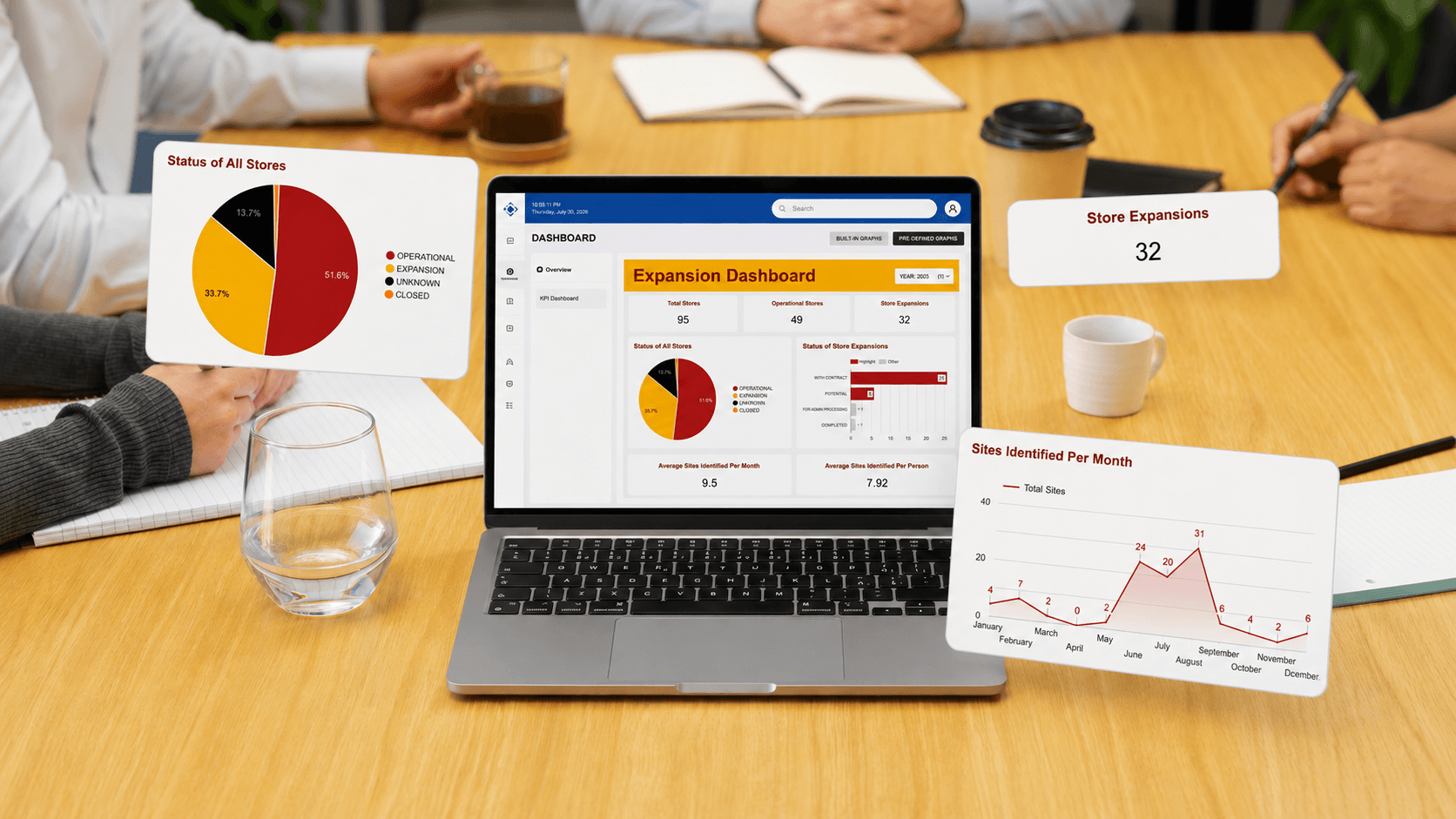
Every business running multiple locations eventually hits the same wall: leadership asks a simple question — how many sites are operational, how expansion is tracking — and the answer takes a day to pull together instead of a minute. A location intelligence dashboard is built to close exactly that gap, consolidating store status, contract stage, and field activity into one live view instead of scattered files updated by different people at different times. Without it, decisions get made a week late, or on information that’s already stale — and that delay is the real cost.
Businesses with multiple locations, ongoing expansion plans, or field-based operations tend to run into the same three problems:
According to McKinsey’s The Data-Driven Enterprise of 2025, organizations that process and deliver data in real time are better positioned to outperform peers relying on delayed or siloed reporting.
Rather than listing features, it’s more useful to look at the questions a location intelligence dashboard should be able to answer on sight:
“How much of our network is actually running?”
A live breakdown of store or site status — Operational, Expansion, Unknown, or Closed — gives an immediate read on network health, instead of an estimate pieced together from memory.
“Where is expansion actually progressing?”
Tracking sites by pipeline stage — With Contract, Potential, For Admin Processing, Completed — shows exactly where deals are moving and where they’re stuck, so intervention can happen before a delay becomes a missed target.
“Is our field team’s pace on track?”
Metrics like average sites identified per month, or per team member, turn field activity into a measurable, comparable number for planning and coaching.
The value of a location intelligence dashboard isn’t the interface — it’s the operational shift it enables:
TACTIC (Territory Analysis & Coverage Tool with Information Capture) was built around this exact need — a location intelligence dashboard where field data gathered through tools like CaptureMe is consolidated, visualized, and turned into real-time status views. Instead of assembling a picture from multiple sources, teams work from one shared, live view of their stores, sites, and expansion pipeline.
For businesses managing multiple locations or an active expansion plan, that shift — from scattered updates to one location intelligence dashboard — often has more impact on decision-making speed than any single feature on its own.
If your team is still piecing together status updates from different files and departments, a location intelligence dashboard can close that gap.
This website uses cookies to ensure you get the best experience on our website. Learn more